There are Indian white eyes with Tsee Tsee calls and then there are the real conversationalists. — The quiet conspirators of the undergrowth — Puff-throated Babblers — small, earthy, and endlessly alive.
You rarely see one alone.
Like the white eyes, they move as a unit, low on the forest floor, rustling through leaf litter with purposeful urgency. Brown, buff, and subtly patterned, blending almost perfectly into the forest’s fallen tapestry. Their pale throats — which give them their name — puff slightly as they call, producing a series of soft, conversational notes that feel like dialogue and witnessing a small committee at work.
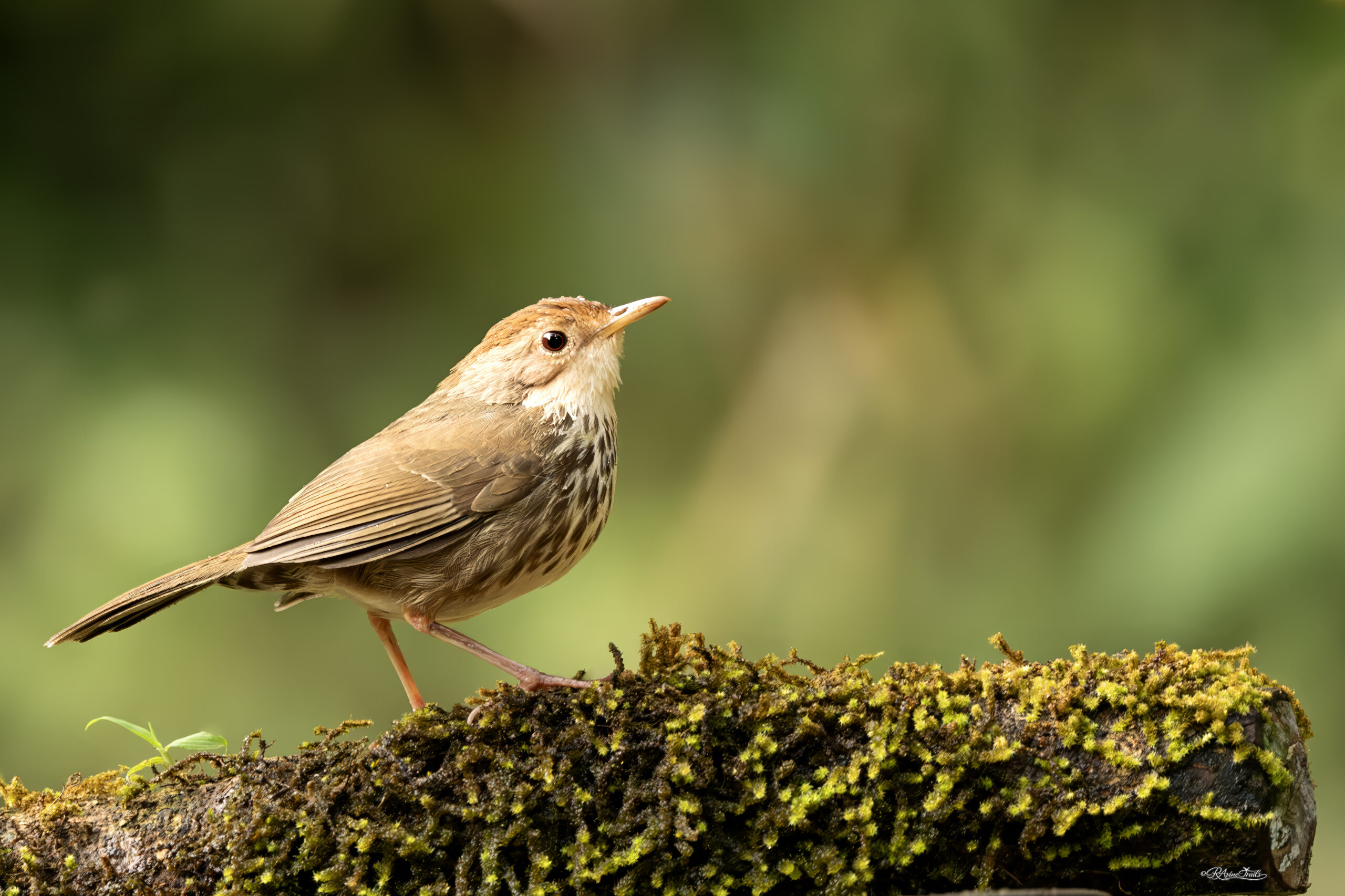
One scratches at damp leaves.
Another hops onto a mossy log.
A third pauses, alert, scanning.
Then suddenly — a burst of motion.
Reflections
Puff-throated Babblers are quintessential understorey birds of the Western Ghats. They prefer dense, shaded forests where thick leaf litter shelters insects and small invertebrates. Their feeding style is energetic but grounded — scratching, probing, turning leaves with quick flicks of their bill.
They are often part of mixed-species foraging flocks, benefiting from collective vigilance. Safety lies in numbers. Communication is constant — soft calls that maintain contact in thick vegetation where visibility is limited.
Unlike flamboyant species that rely on color for recognition, babblers rely on proximity and sound. Their world is one of closeness.
Conservation Significance
The Babblers do not perform. They do not pose. They simply live — fully, busily, collaboratively. Standing quietly in the forest, you begin to tune into their rhythm: the scratch of leaf against leaf, the subtle trill exchanged between flock members.
And then you notice how dependent that rhythm is on intact forest floor.
Remove the undergrowth. Clear the litter. Simplify the habitat and the babblers lose their stage.
Their survival depends not on towering trees alone, but on what lies beneath — the damp decay, the insects, the layered complexity that many overlook. In forests disturbed by excessive clearing or manicured too neatly along trails and resorts, their presence becomes thinner.
Like many understory specialists, they do not adapt easily to open spaces.They fade with the forest floor.
Fieldcraft
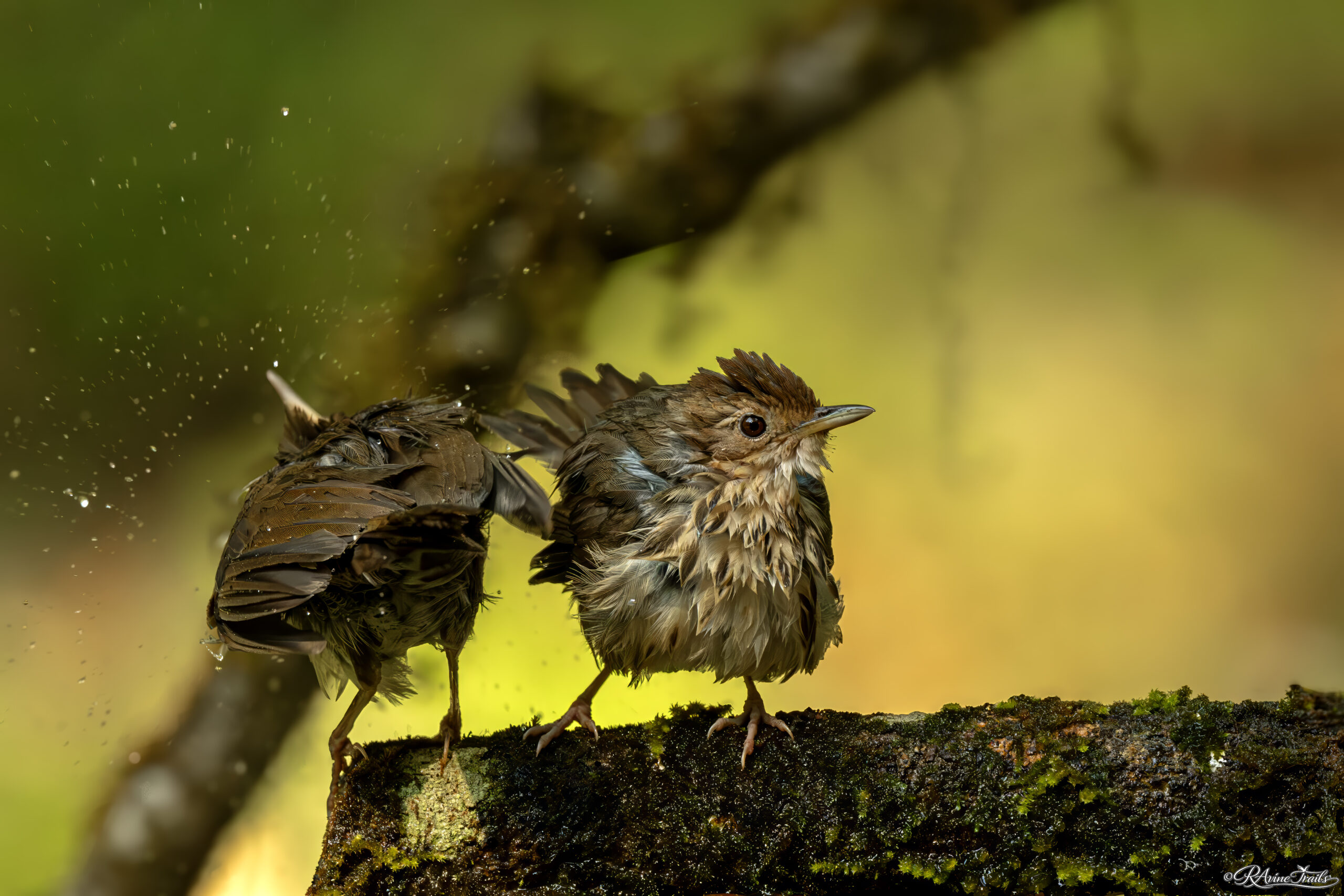
Photographing babblers is an exercise in readiness. Light becomes everything, they rarely sit still for long, and their earthy tones demand careful exposure to avoid losing feather detail against similarly coloured backgrounds.
In this moment, the backlit droplets elevate the frame. A fast shutter speed freezes the arc of water mid-air, transforming a routine shake into a dynamic story. Without that speed, the moment dissolves into blur. With it, time pauses.
The warm golden background contrasts beautifully with the cool moisture in flight, creating depth. The moss-covered perch anchors the composition and most important is the eye contact. Even in Chaos, if the eye is sharp, the story holds
The Puff-throated Babbler will never headline birding checklists. It does not glow with iridescence or tower above the canopy. But it carries something equally valuable — authenticity.
It reminds us that forests are not only built of giants. They are sustained by small, collaborative lives at ground level.
And sometimes, the most memorable moments are not the grand displays — but the simple, joyful shake of feathers in filtered light. In the quiet understory, the babblers continue their conversation. The forest listens.