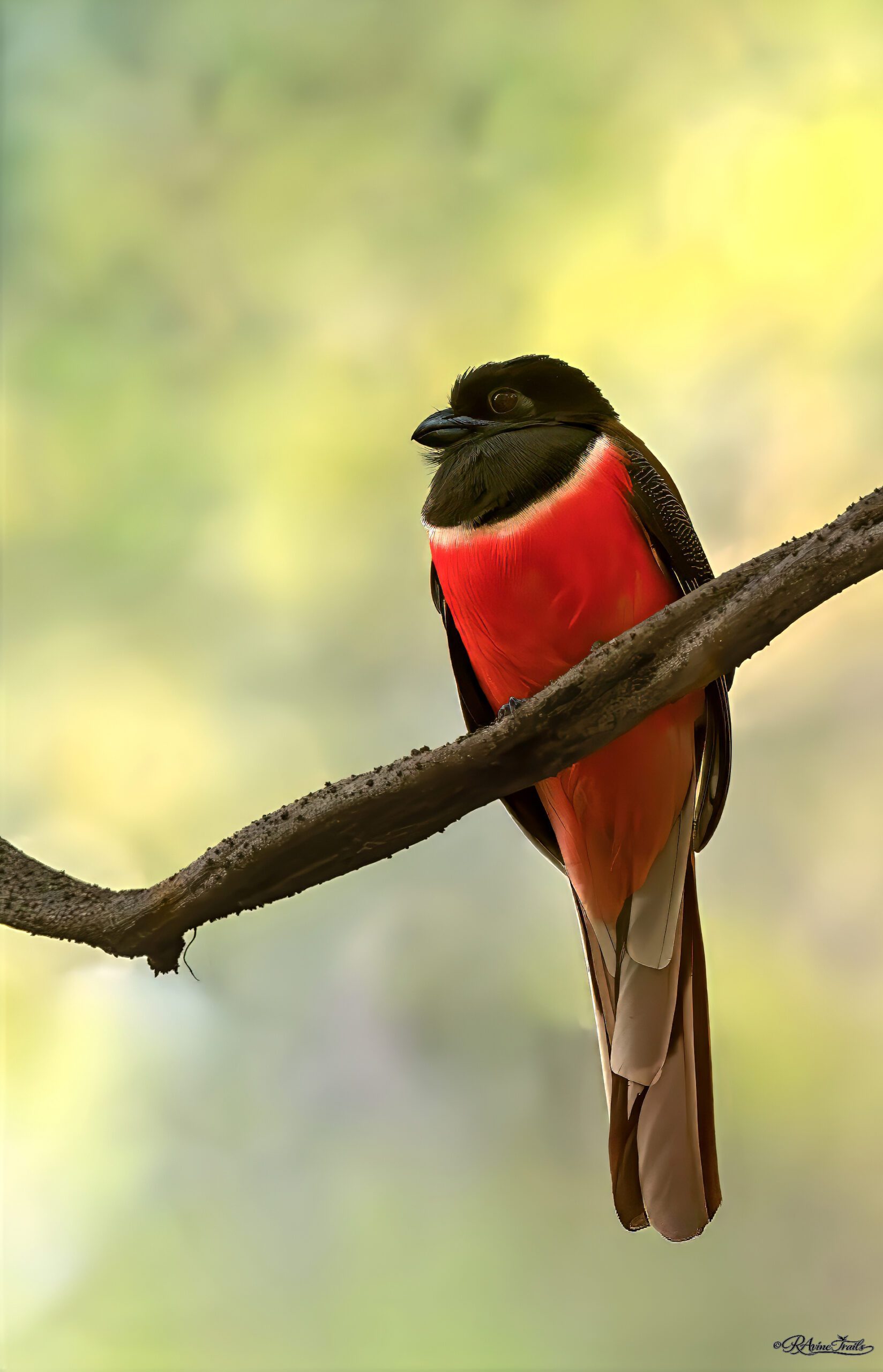
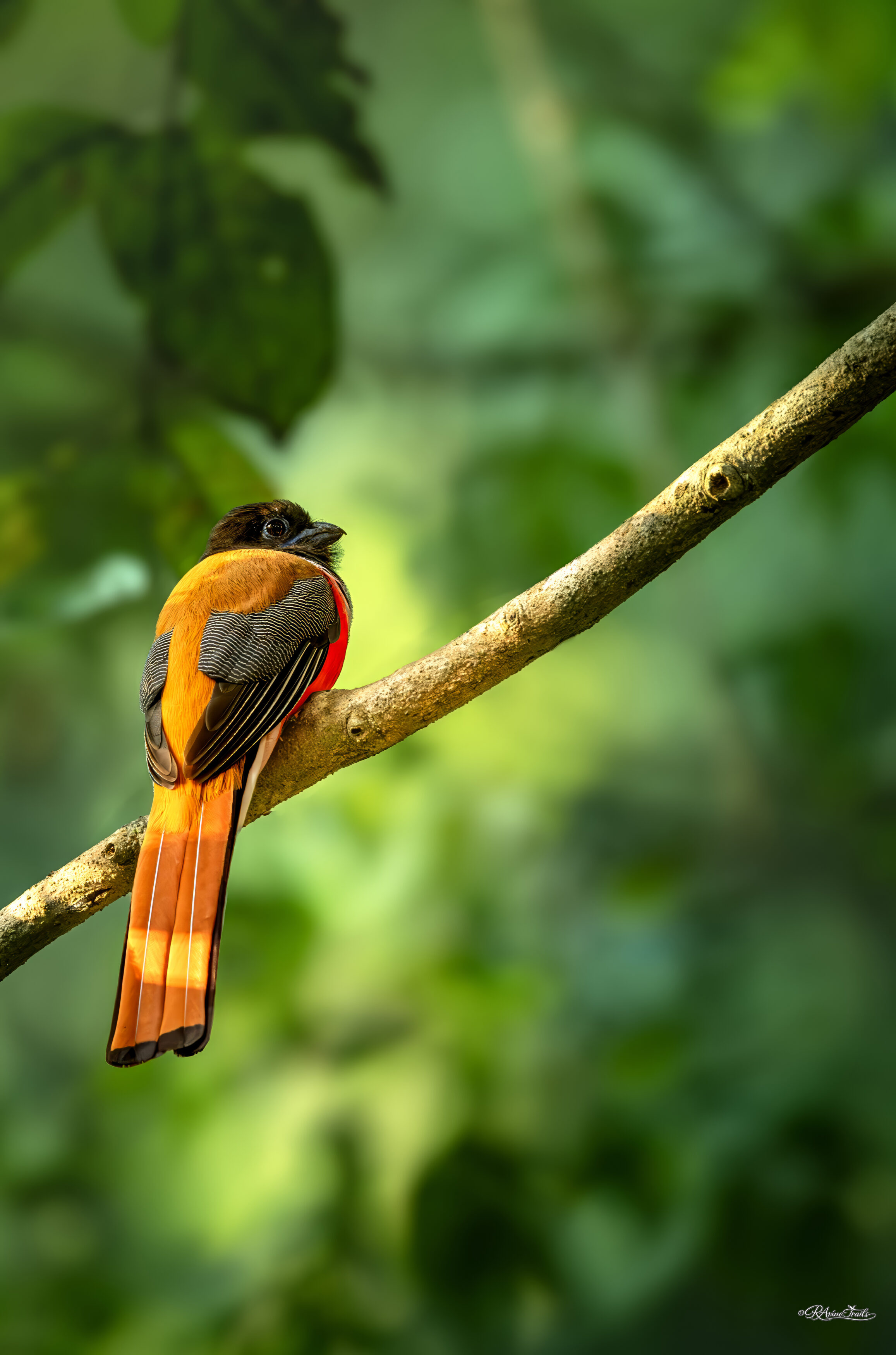
Endemic to the forests of the Western Ghats and parts of Sri Lanka, A presence felt long before it is fully seen, The Malabar Trogon is not a bird of open skies or dramatic flight. It belongs to moss lined trunks and the hush between leaves where light gets filtered multiple times before it falls on the bird, a male seen here that carries a striking elegance: a velvety black head and throat, a crisp white collar, intricately patterned wings, and that unmistakable burnt-orange to crimson belly which glows like quiet ember against the forest’s green tapestry.
Reflections
The Trogon practices stillness unlike many birds that flick and flutter restlessly. It perches motionless for long stretches, scanning patiently for insects, small reptiles, or forest invertebrates. When it moves, it does so with intention — a short, direct flight to snatch prey mid-air before returning to its chosen perch. Its call, a soft series of whistling notes, carries gently through the forest, often revealing its presence before your eyes can locate its form.
And that is part of its magic.
The trogon rarely perches in the open. It prefers slanting branches beneath a shaded canopy, always framed by leaves, never demanding attention. To spot one is not merely luck — it is a reward for patience. You must slow your breathing. You must let the forest reveal itself at its own pace. In doing so, you begin to see differently.
Watching a male Malabar Trogon bask in the first sun rays brings a childlike stillness. The forest seems to pause with him. Time loosens its grip. In that silence, one understands something essential: wild beauty does not perform for us. It exists entirely for itself. We are merely fortunate witnesses
Conservation Significance
The bird is a quiet indicator of forest health. Dependent on dense, undisturbed evergreen and semi-evergreen forests, its presence signals intact understorey structure and rich insect life. Because it is sensitive to habitat fragmentation and logging, conserving landscapes for this trogon indirectly safeguards countless other endemic species that share its ecosystem. Unlike woodpeckers, it nests in decaying tree trunks without chiselling extensively, relying on naturally softened wood—another reminder of the importance of old-growth forests.
Fieldcraft
Capturing an image is both a gift of emotion which emerges only when we are present enough to feel the moment and a technical challenge. Its saturated plumage contrasts beautifully against soft green bokeh, especially in the gentle light of early morning. The key lies in restraint — allowing a non existing space around the bird to breathe, exposing carefully for the highlights along the white collar while preserving detail in the dark head. Because the bird often sits still, composition becomes paramount. The angle of the branch, the direction of gaze, and the separation from the background determine the natural color harmony.
In a world that grows louder and faster, the Malabar Trogon remains what it has always been — a quiet flame in the shadows of ancient forests. Elusive. Unhurried. Complete.
And perhaps that is why encountering him feels less like observation and more like a gentle reminder: to move softly, to look longer, and to let the wild remain wild.