When you see a Blue capped rock thrush in a forest, colour does not merely appear — it arrives. The Blue-capped Rock Thrush is one such arrival.
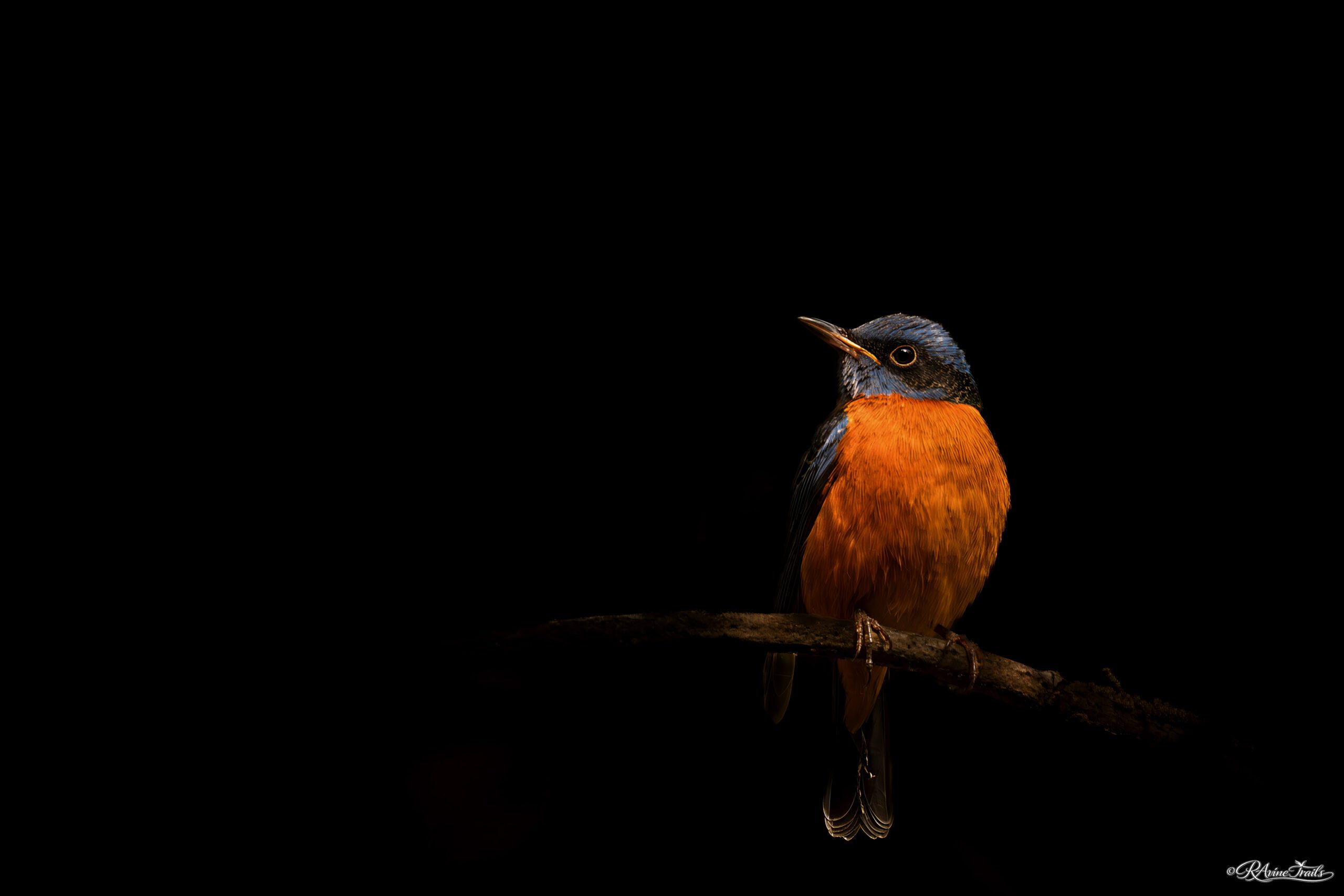
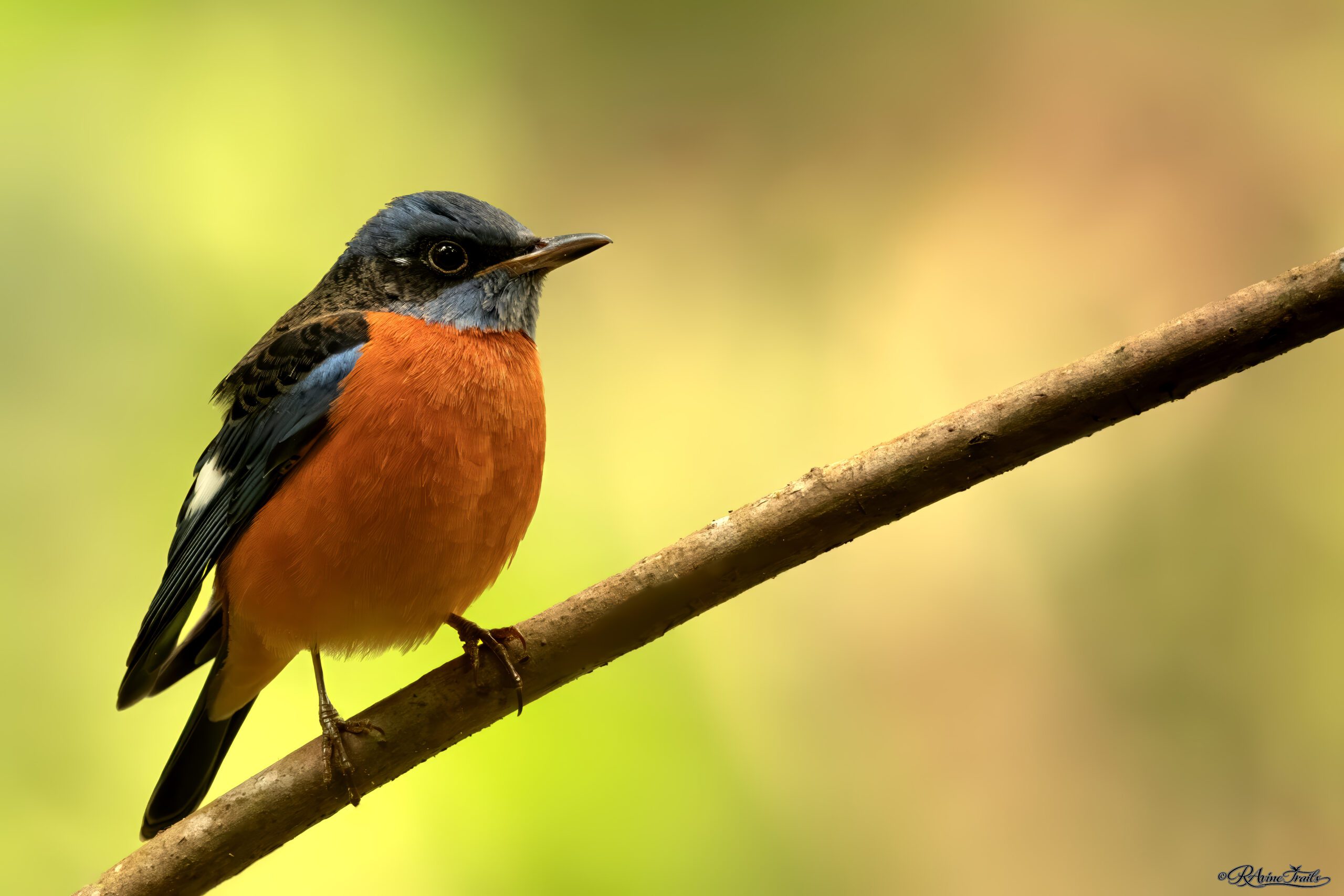
Perched against a deep shadow or glowing bokeh, the male looks unreal — a slate-blue crown and face resting above a blaze of burnt orange that seems lit from within. In certain light, he feels less like a bird and more like two different flames suspended in space.
Reflections
There is something arresting about seeing this bird for the first time in a season.
It prefers quiet perches along forest edges, wooded clearings, rocky outcrops, and sometimes shaded garden groves. Often solitary, it watches from mid-level branches before dropping swiftly to the ground to capture insects.
It is a migrant visitor to many parts of peninsular India, arriving with seasonal shifts and departing just as quietly. Unlike resident forest birds, it carries a sense of transience — a traveller pausing briefly in borrowed landscapes.
Its hunting style mirrors that of many thrushes: patient observation followed by decisive movement. A short flight. A quick hop. A return to perch.
Stillness, then precision.
Conservation Significance
The Blue-capped Rock Thrush feels like a seasonal gift — a reminder that migration connects landscapes far beyond our view. It arrives, hunts quietly, glows in filtered light, and then moves on.
In a forest increasingly fragmented by development, the continuity of safe resting grounds becomes vital. Migratory birds depend not just on breeding habitats, but on stopover sanctuaries. Remove the trees. Simplify the undergrowth. Disturb the quiet edges.
And the traveller may never return.
Fieldcraft
This is a bird that thrives on quiet edges. Rocky clearings, forest margins, semi-open perches where it can watch without being watched. The first rule of fieldcraft here is not technical — it is spatial awareness.
Do not advance in straight lines. A direct approach reads as threat. Instead, move obliquely. Pause often. Let the bird grow accustomed to your silhouette. The thrush tolerates stillness far better than motion. Once it accepts your presence as non-threatening, it resumes its rhythm — perch, scan, drop, return.
That return is your moment. Unlike hyperactive flycatchers, the Blue-capped Rock Thrush often favours a chosen vantage point. If you resist the urge to chase its first movement and instead observe its pattern, you begin to understand its circuit. Patience replaces pursuit.
With a bird this luminous and seasonally scarce, the temptation is to press the shutter repeatedly — to secure the shot from every angle. But ethical fieldcraft demands something quieter. One or two assured frames. Then stillness again. Because this species is migratory in many parts of India, its energy reserves matter. Every unnecessary flush costs fuel. Every disturbance disrupts feeding.
The true strength lies not just in balancing blue and orange — but in balancing ambition and empathy.
A photograph of a lifetime does not require domination of the moment. It requires understanding it.
Standing before such colour, framed by silence, one is reminded that beauty in the wild is often fleeting — not because it is fragile alone, but because it is always in motion.
A flame against the dark.
A pause in a long journey.
A season written in blue and orange.