Brown Headed Barbet – The Patient Carpenters of the Canopy
The white cheek barbet or the coppersmith flash across your field of vision. The Brown headed Barbet sits, absorbs light, and become part of the tree itself. This rarely seems in a hurry. Its mossy green body blends seamlessly into foliage, while the warm brown head and striking orange orbital patch lend it an expression of zen that not other bird has. The thick, coral-red bill is a tool. A chisel. A sculptor’s instrument.
Reflections
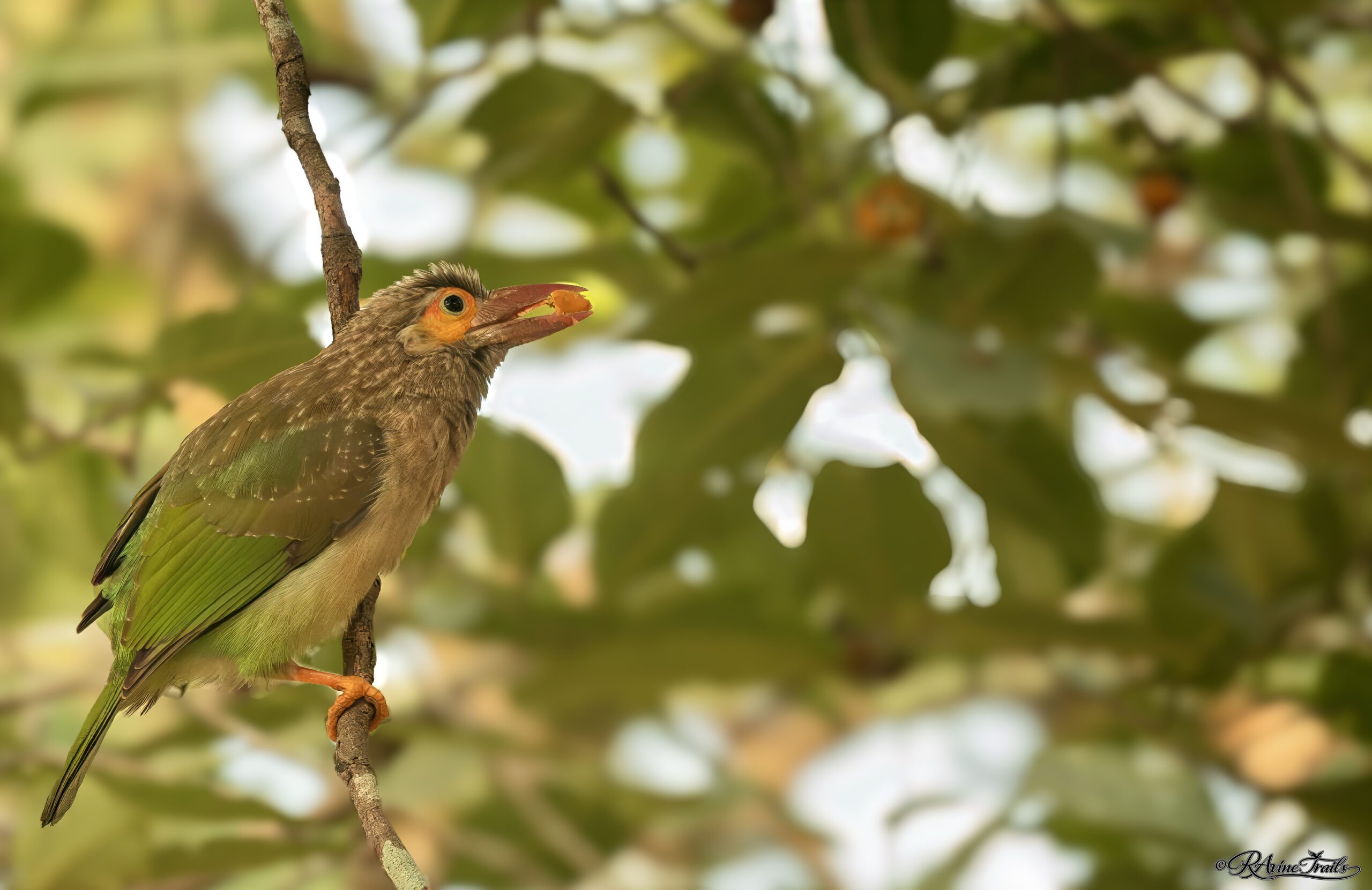
Brown-headed Barbets are fruit specialists, though they will occasionally take insects. Figs are a favorite. They move methodically among branches, pausing for long stretches before plucking fruit with careful precision.
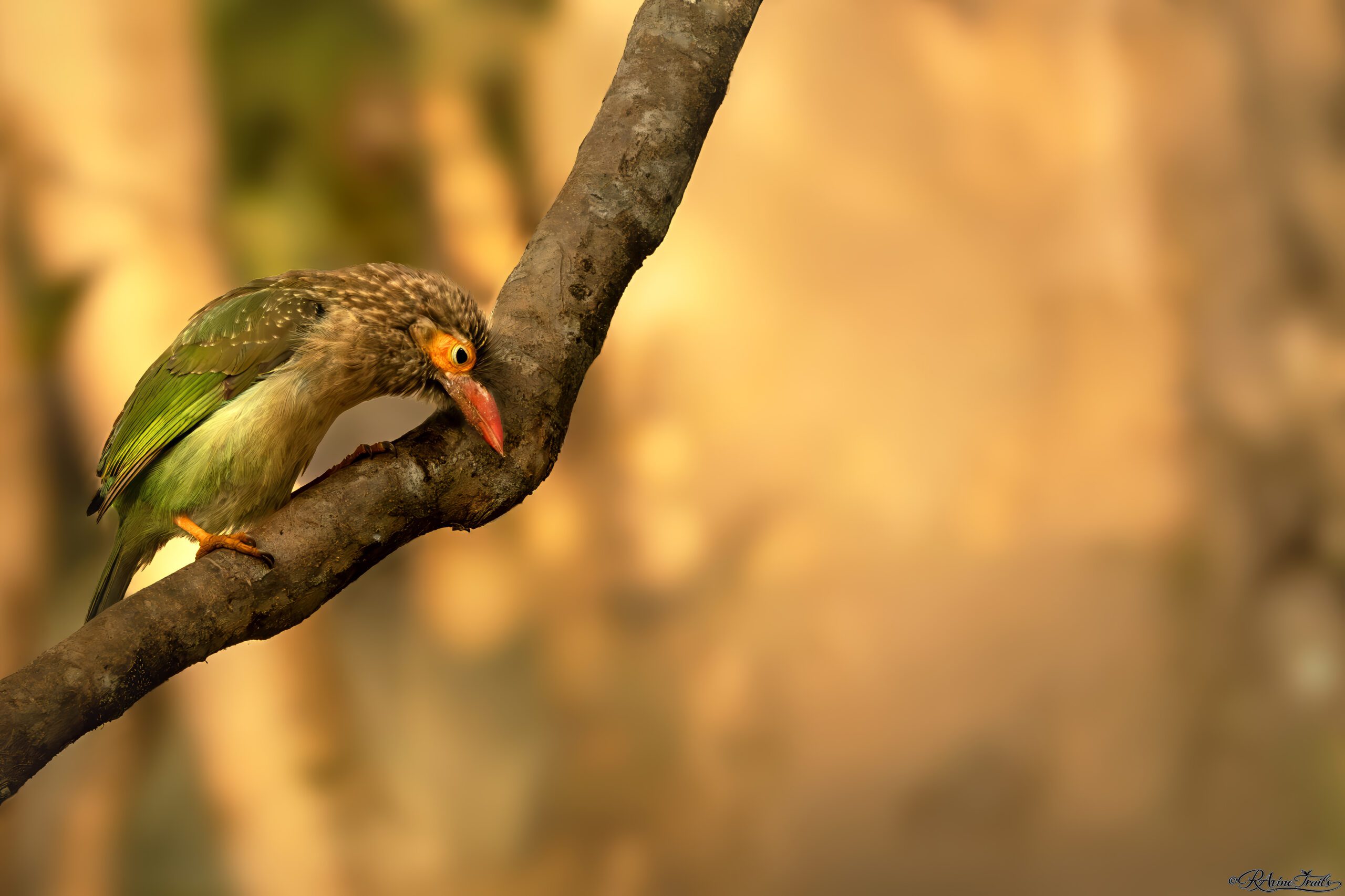
But one behavior stands out — the lean.
Watching a Brown-headed Barbet lean into a branch is calming. No performance. No exaggerated display. Just the presence. The forest around it continues — leaves rustle, insects hum — and the barbet simply rests, anchored to wood as though rooted, as though the tree and the bird become one.
The barbet presses its body gently against a branch, feathers relaxed, head slightly tucked, eyes half-closed. To the casual observer, it appears asleep. In reality, this posture is often one of rest or thermoregulation — conserving energy between feeding bouts, especially in the warmth of the day.
Unlike more restless species, barbets conserve motion. They can remain still for extended periods, blending into bark and leaves so effectively that one might overlook them entirely.
And then comes their other identity — the drummer. With rhythmic persistence, they excavate nest cavities in soft wood. Their repetitive, hollow tapping carries across quiet groves. These self-made cavities not only shelter their young but later provide homes for other secondary cavity-nesting species. In this way, they are ecosystem engineers.
Conservation Significance
Even such grounded species depend heavily on mature trees — not just for fruit, but for nesting cavities. The removal of old trees, the pruning of deadwood, and the clearing of natural groves quietly reduce opportunities for breeding.
A forest without aging trunks is a forest without future homes.
Fieldcraft
Its plumage carries subtle gradients — olive green, moss, brown, yellow-green — and these can easily flatten under harsh light. Golden hour enhances the warmth of the head while preserving feather texture along the wings. Sharp focus on the eye is essential. The orange ring becomes the emotional anchor of the frame and creates a visual harmony. Giving this bird room to breathe is not easy, it hops between fruiting branches often away from the view and darts exceptionally fast when threatened or disturbed. Capturing the behaviour becomes essential to the narrative of its survival.
The Brown-headed Barbet is not an uncommon bird. It does not demand applause. It sits, feeds, carves, rests — sustaining the quiet architecture of the canopy.
In a world that prizes constant motion, the barbet teaches stillness.Press gently against the branch. Hold your ground. Let the forest carry on around you. And when the time comes, pick up your chisel and build something that lasts.