Drongo – The Bird With Multiple Personalities
A Drongo is never just one thing.
Across fields, forests, and wooded edges, members of the genus Dicrurus carry a shared silhouette — upright posture, glossy or slate-toned plumage, and that unmistakable forked or elongated tail. But within that outline lives a spectrum of personalities as varied as the landscapes they inhabit. Perched with quiet authority on a slender branch, it surveys its world with unwavering composure. There is nothing flamboyant about its plumage — no blaze of crimson or flash of cobalt — and yet, it commands attention.
The Drongo does not need brilliance to be noticed. Its confidence lies in presence.
In Ganeshgudi, the drongo wears three masks…
| Species | Temperament | Habitat | Signature Behaviour |
|---|---|---|---|
| Ashy | Agile | Woodland edge | Aerial sallies |
| Black | Bold | Farmland, open fields | Fearless mobbing |
| Racket-tailed | Enigmatic | Dense forest | Vocal mimicry |
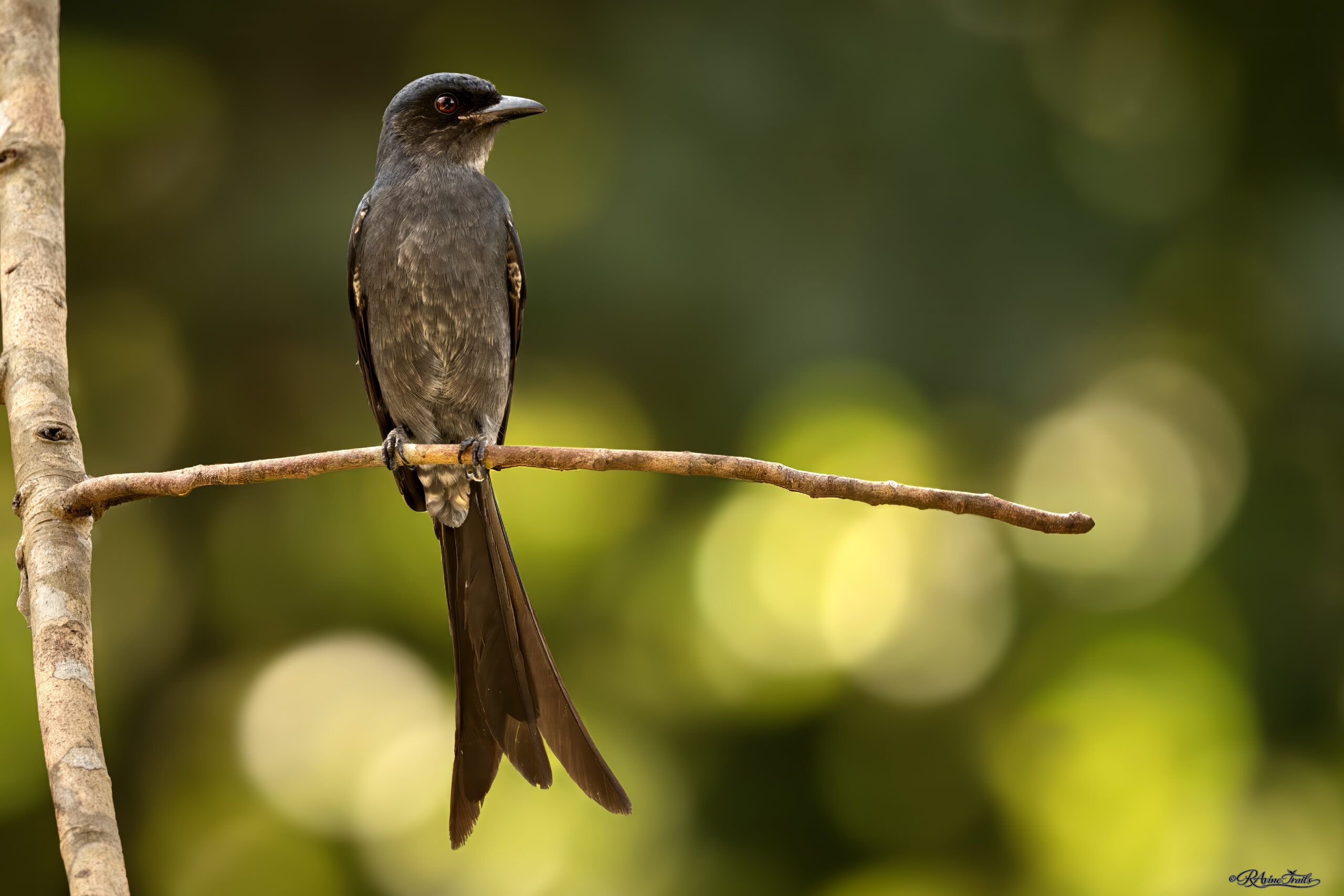
The Composed Woodland Hunter – Ashy Drongo
The Ashy Drongo has a quieter presence, it does not reveal its presence. It endures
Less flamboyant, more understated in tone, it inhabits wooded habitats with quiet confidence. Slate-grey against filtered light, it waits with patience before launching into precise aerial sallies. It may not advertise its strength as boldly as its black cousin, but it carries the same sharp intelligence.
Alert. Calculated. Efficient.
Its personality feels contemplative — less confrontational, more measured.
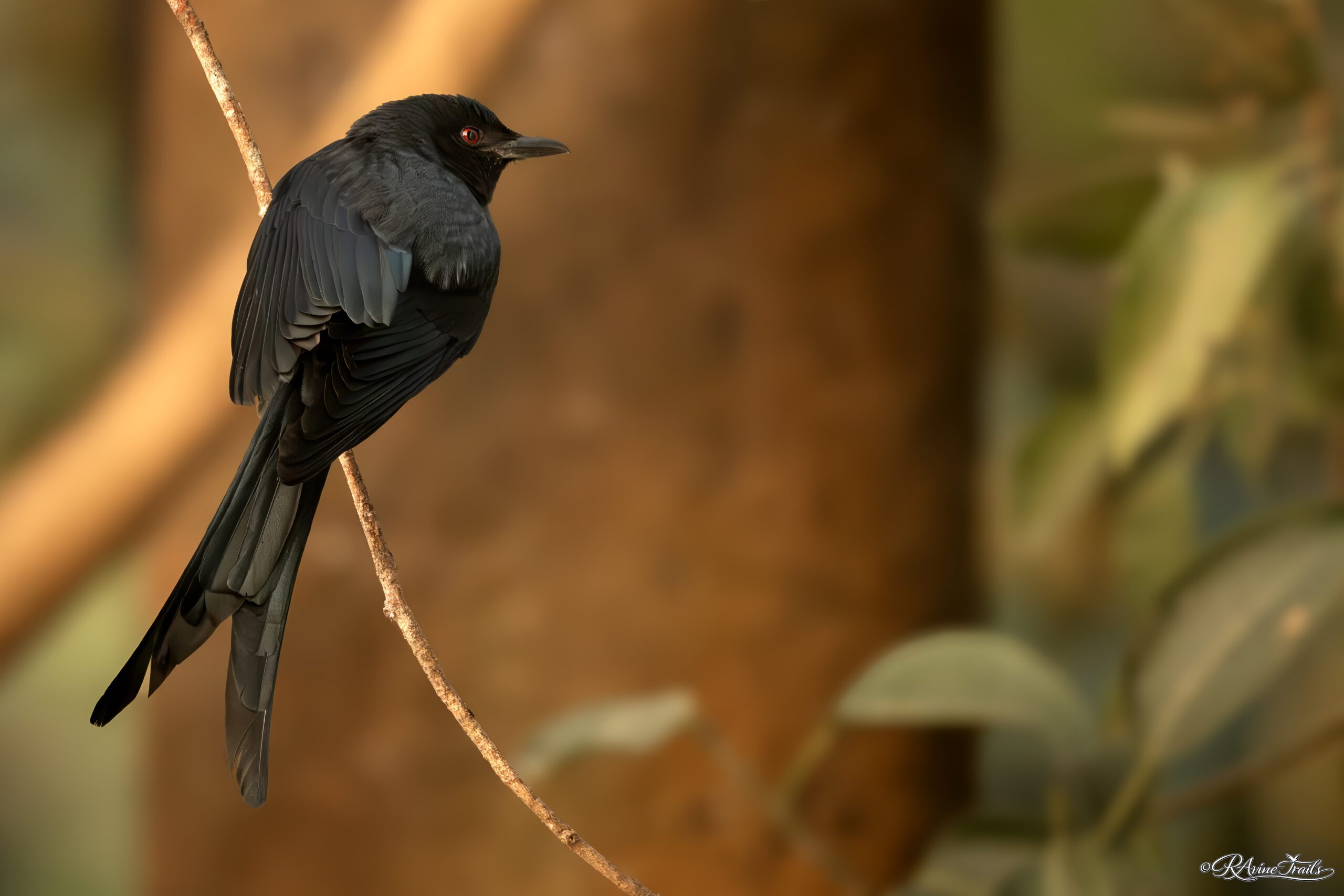
The Fearless Guardian – Black Drongo
If boldness had feathers, it would look like the Black Drongo.
Often seen perched prominently in open farmland or roadside wires, it surveys its territory like a vigilant sentinel. When a raptor passes overhead, the Drongo does not retreat. It advances. Dive-bombing eagles and kites many times its size, it defends its space with astonishing courage.This is the Drongo most farmers recognize — an ally in insect control, a defender of its patch of sky. Feisty, territorial, and unapologetically assertive, it has earned the nickname “King Crow.”
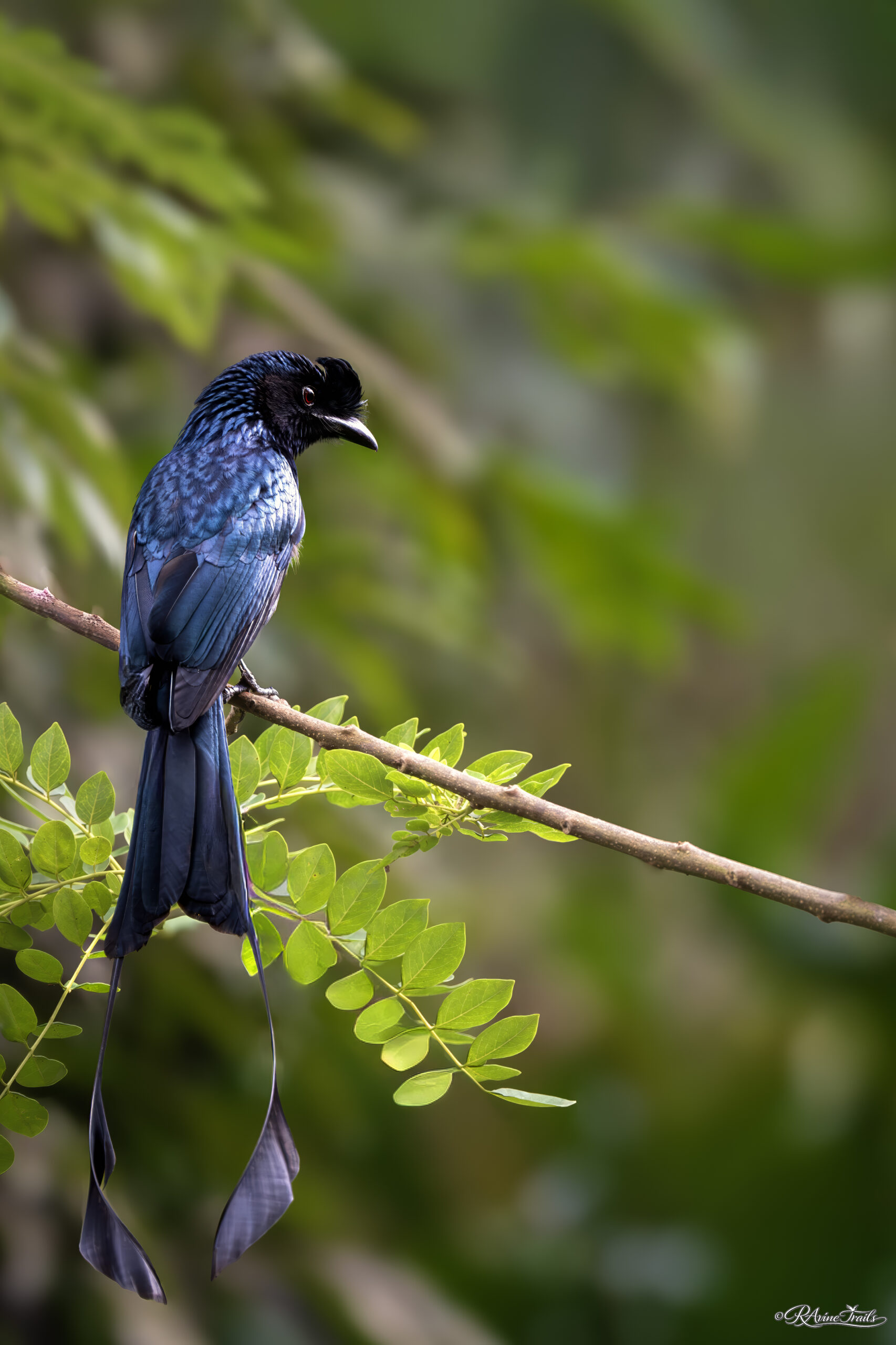
The Master Mimic – Greater Racket Tailed Drongo
In the dim understory of evergreen forests, another personality emerges — theatrical, intelligent, and cunning.
The Greater Racket-tailed Drongo is a virtuoso of mimicry. It can replicate the calls of multiple bird species with startling accuracy. In mixed-species flocks, it listens, learns, and sometimes manipulates — imitating alarm calls to startle other birds and seize unattended prey. Its elongated tail streamers sway like pendulums as it calls out a repertoire that can sound like an entire forest compressed into one body.
This is the strategist — observant, adaptive, and deeply aware of its surroundings.
Reflections
This bird is a master of arial agility. It does not rush. It waits. It calculates and from its vantage point, it launches into quick, precise sallies to catch insects mid-air before returning to the same perch — a repeated rhythm of watch, dart, return.
Its posture is upright, almost regal. It scans constantly, head slightly tilted, eyes sharp and reflective. Drongo’s are also known for their boldness. They do not hesitate to chase away larger birds that intrude upon their feeding territory. Fearlessness, despite modest size, is a defining trait.
The species is a perfect example representing stillness with purpose. That forked or racket tail sways slightly in balance, the body aligned with the branch as though part of it. Even in silence, there is awareness — a constant reading of wind, light, and opportunity.
Their calls vary — whistles, harsh notes, mimicry — adding complexity to their forest identity. In mixed-species flocks, they often assume the role of vigilant overseer, benefiting from the movement of other birds that flush insects into the open.
They are not merely participants in the forest — they are strategists.
Conservation Significance
Drongo’s thrive in forests, woodland edges, plantations, and open groves — but only where insect life remains abundant. The gradual thinning of tree cover, pesticide-driven insect decline, and fragmentation of woodland corridors quietly erode their hunting grounds.
The disappearance of insects does not echo loudly in the forest. It happens quietly — and with it, the rhythm of species like the drongo begins to falter.
For insects to survive, pesticide-free plantations are not a luxury but a necessity. In wooded landscapes, the quiet decision to leave fallen leaves and decaying trees undisturbed sustains an entire microcosm of life. Leaf litter shelters larvae, beetles, ants, and countless unseen invertebrates. Rotting wood becomes nursery, refuge, and feeding ground.
From this hidden abundance rises an intricate food web. Beneath the canopy, an entire world of birds, reptiles, and small mammals depends daily on these insects for survival. When we clear too thoroughly, spray too freely, or tidy the forest floor into silence, we do not just remove debris — we erase the foundation of life that countless species rely upon.
And the forest grows quieter.
Fieldcraft
Three species.
Three temperaments.
One shared lesson
All three drongos demand attentiveness to body language. A subtle crouch signals flight. A raised crest may precede a call. The forked tail, whether modest or extravagant, is always central to the composition. From behind the lens, drongos teach anticipation, restraint, and timing. They are birds of intelligence and agility.
The Black Drongo is a gift to the photographer — bold, visible, and unapologetically present. It prefers exposed perches: fence wires, open branches, isolated shrubs. Composition becomes clean and graphic. The glossy black plumage, however, demands precision. The real challenge lies in action. The Black Drongo launches without warning. A slight forward lean, a tightening of posture — and it’s airborne. Fast shutter speeds are essential to freeze aerial sallies or mid-air insect captures. Anticipation is everything. With this drongo, the lens must be ready for drama.
In contrast, the Greater Racket-tailed Drongo is a compositional puzzle. Dense forest light, layered backgrounds, and dramatic tail streamers demand thoughtful framing. The elongated “rackets” can easily clip the edge of a frame if not carefully composed. Space becomes crucial — negative space above and below the perch enhances elegance. Lighting is trickier because this bird is the master mimic and is almost always under canopy cover.
The Ashy Drongo offers a subtler palette. Slate-grey feathers absorb and soften light beautifully, especially in early morning warmth. Unlike its jet-black cousins, tonal variation is easier to preserve The Ashy feels contemplative in frame — less theatrical, more refined. The goal is not spectacle, but mood.
The many personalities of a Drongo remind us that strength is not singular.
It can be bold and confrontational. It can be cunning and strategic. It can be calm and observant. But in every form, it depends on the quiet integrity of the ecosystem it commands. And perhaps that is the final lesson the Drongo offers —
The Drongo waits.
Nature responds.
And in that quiet exchange lies the true authority and the fragile harmony of the wild.